Why We Choose Early Neuter for Our Male Maine Coons
Health, Prevention, & Responsible Breeding Practices
One of the most common questions we hear is, “Why do you neuter your kittens so young?”. It’s a fair question, and one we’re happy to explain. Our male kittens are neutered at approximately 14 weeks of age and placed into their homes after 17 weeks, once they are healed and ready for the transition.
Early Spay & Neuter (ESN) is debated, and we won’t pretend it isn’t. Some breeders prefer to wait. Some veterinarians are more comfortable with later timelines. We respect that people can disagree and still be responsible. This is a topic that you will see vary from pet owner to pet owner, breeder to breeder, vet to vet, and so on.
That being said, after careful research, heavy consultation with our veterinarian, and real-life experience, we personally choose ESN. We choose it because we believe prevention matters, and because we love this breed too much to gamble with avoidable risk. We’ve also experienced what it’s like (twice) for a kitten family to choose to be irresponsible, and breed their kittens who should’ve been spayed or neutered, and for that, I “vowed” for it to never happen again. We’ve been following this protocol for a little over three years, and in all that time, we haven’t had a single complication within the surgery or recovery period (well, beyond the kittens wanting to bounce off the walls during their recovery time. It’s so hard to keep them still!) and we are extremely grateful for that. The reason is simple: neutering saves lives, prevents unnecessary suffering, and helps every kitten grow into a happy, well-adjusted companion.

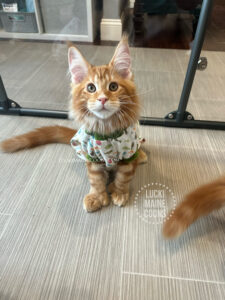
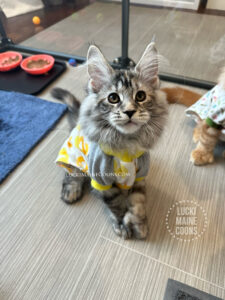
Take a look at this cuteness. Back from their spay and neuters & in their surgery PJ’s, the kittens are back to having fun. Pictured above is Little Red Corvette, Red Tabby boy in the green sleeved outfit, Delirious, Red Tabby boy in the gray sleeved outfit, & Paisley Park, Black Silver Torbie girl in the yellow sleeved outfit.
What Does “Early Neuter” Mean for our Maine Coons?
Early Spay & Neuter, sometimes called pediatric spay/neuter, simply means sterilizing kittens before sexual maturity, usually between 8 and 16 weeks. “Early” doesn’t mean too early. It means performing the procedure when a kitten is healthy, strong, and in the ideal developmental window. At 14 weeks of age, kittens tolerate anesthesia well, recover quickly, and heal in just a few days.
The American Veterinary Medical Association (AVMA) supports early-age spay/neuter when it is performed by trained professionals on healthy kittens. You can read their position statement here:
https://www.avma.org/
The American Association of Feline Practitioners (AAFP) also recognizes ESN as a valid option within feline practice guidelines:
https://catvets.com/
From a practical standpoint, studies comparing pediatric neuter patients to traditionally aged patients have shown that kittens often tolerate anesthesia very well, surgical time is commonly shorter, and recovery can be remarkably quick. In our home, we’ve experienced that part is not just research, it’s reality. They truly bounce back faster than you’d believe. Most of our boys are back to themselves by the next morning, and many of them are already bouncing off of the walls again the same day we bring them home from the vet. Kittens are incredibly resilient, and we’re thankful for smooth recoveries.
Does Early Neuter Affect Growth in Male Maine Coon Cats?
As with females, there is not sufficient feline-specific research proving that early neuter negatively affects growth or structure in cats. Much of the concern people hear online originates from canine studies involving large dog breeds. Those findings are often generalized to cats, but cats are not small dogs and feline growth + orthopedic development are different.
In cats, available research does not show stunted growth caused by early neuter. Some veterinary discussions suggest early sterilization may slightly delay growth plate closure, which could result in slightly longer limbs rather than smaller cats. What truly drives Maine Coon size is genetics and nutrition, and in our program, our early-neutered males mature into large, well-proportioned, structurally correct Maine Coons. Hormones alone do not define structure.
If ESN routinely caused stunting or structural problems in cats, we would see it in our own kittens that have grown up. We have not had any problems reported in regards to stunted growth or structural problems, we have also not experienced any hip related issues connected to ESN. Our past kittens that have been ESN are the same size and structural build as kittens that were born prior to us practicing ESN.
Hormones, Behavior, & Why Timing Matters
Male Maine Coons can begin showing hormonal behaviors as early as five to seven months of age, some even as early as four months. Once testosterone levels rise, certain behaviors can begin to appear. These often include strong-smelling urine, spraying, territorial marking, vocalization, and increased roaming instincts. It is important to understand that these behaviors are not “bad”, they are biologically driven.
However, once spraying begins, it can become habitual. Waiting until after hormonal behaviors are established can make them harder to reverse in some cats. Early neuter prevents the development of testosterone-driven behaviors before they begin. In pet homes, this makes for a smoother transition, less stress for families, and a calmer overall environment.
Health Considerations for Male Maine Coons
Unlike females, male cats do not face risks like pyometra or mammary tumors. However, neutering still plays an important role in overall wellbeing. Intact males are more likely to roam, which increases the risk of injury, fights, and exposure to infectious disease such as FIV or FELV. Roaming behavior is hormone-driven. In multi-cat environments, intact males are also more likely to display dominance-related tension.
Early neuter significantly reduces these risks by eliminating the testosterone-driven behaviors that lead to them. Neutered males generally experience lower stress levels in household environments and integrate more easily into family life.
Responsible Breeding and Responsible Pet Ownership
We are big believers in intentional breeding. Not every cat should reproduce, and breeding should never be casual. When breeding is done responsibly, it is planned and purposeful. When it’s done irresponsibly, it becomes accidental litters and ultimately contributes to a bigger population problem.
While Maine Coons are not the primary contributors to shelters, the overall reality remains that there are more cats than homes. Responsible breeders should model responsible pet ownership, and pet owners should protect their cats from preventable health risks. Early neuter helps prevent accidental litters and ensures that our kittens cannot be bred without authorization. It protects the cat, protects families, and supports ethical stewardship of the breed.
If You Prefer a Breeder Who Does Not Practice ESN
We want to be transparent and respectful. If you are specifically looking for a breeder who does not practice Early Spay & Neuter, then we are not the breeder for you. We do not adjust our policy case-by-case. We do not make exceptions, (unless for potential health risk of a specific kitten, that would then be discussed with our veterinarian & said kitten’s family). Our kittens are placed after they have been spayed/neutered and are healed, and we are not willing to change that rule at this time.
That doesn’t mean other breeders are wrong. It simply means our program has a specific philosophy, and it matters to us that families align with it. With that being said, we do have a few breeder friends who do not practice ESN, and we would be more than happy to recommend them to you.
The “Bigger” Myth and Testosterone
Another misconception worth addressing is that leaving a male intact will automatically make him bigger or more impressive. Testosterone does not determine proper Maine Coon structure. Genetics does. Bone structure, hip alignment, body length, and overall proportion are inherited traits. Some people associate intact males with a “more masculine” look, but a neutered male Maine Coon will still develop a strong ruff, full tail plume, and substantial frame.
Here at Lucki Maine Coons, our neutered males mature into beautiful, powerful adults without exaggerated traits or hormonal-driven behaviors. Bigger does not equal better. Correct structure equals better.
Our Commitment to Safeguarding our Maine Coon Kittens
We don’t practice ESN because it’s trendy. We practice it because we believe in prevention, and because we’ve seen what happens when people wait. We’re not interested in our kittens developing
At Lucki Maine Coons, we believe health comes first. We believe structure and longevity matter. We believe responsible breeding means consistent policies and doing what’s right, even when it isn’t popular. Early neuter isn’t about taking something away from a cat. It’s about protecting his future. To give our kitten families complete peace of mind, we align our practices with the official recommendations of these leading animal welfare and veterinary authorities.
The Expert Consensus: Organizations That Endorse ESN
- The American Veterinary Medical Association (AVMA): The AVMA officially endorses pediatric spay and neuter as a safe and effective way to manage feline health and overpopulation.
- The Feline Veterinary Medical Association (FelineVMA): As the leading authority on cat health, the FelineVMA recommends that all cats not intended for breeding be sterilized by five months of age.
- The Cat Fanciers’ Association (CFA): The CFA supports early-age sterilization as a responsible breeding practice to ensure the health and welfare of pedigreed kittens.
- EveryCat Health Foundation: This premier research body funded the foundational studies proving that early spay/neuter has no negative long-term physical or behavioral effects on cats.
- United Spay Alliance: This organization leads the national Feline Fix by Five campaign, which is the current gold standard for the timing of feline sterilization.
These organizations represent the consensus of over 100,000 veterinary professionals and feline experts worldwide.
For the Data Lovers, Peer-Reviewed Research Studies
While these major organizations set the standards, their recommendations are rooted in decades of clinical research. If you’re a ‘data person,’ or just want to learn more about the topic of ESN, here are some key studies that prove ESN is safe and effective for cats:
- Safe Skeletal Growth: University of Minnesota: Effects on Skeletal Development Confirms early sterilization does not stunt the growth of large breeds like Maine Coons.
-
11-Year Follow-up (Safety/Behavior): Long-term Outcome of Early-Age Gonadectomy Proves no long-term physical or behavioral downsides to the procedure.
-
Fast Surgical Recovery: Short-term Results & Complications of Prepubertal Surgery Found kittens under 12 weeks have fewer complications and faster healing times.
-
Anesthetic Stability: FelineVMA: Pediatric Anesthesia & Surgery Guide Clinical data showing how well kittens handle modern anesthetic protocols.
-
Verified Urinary Safety: Feline Fix by Five: Medical Task Force Summary Confirms that ESN has no impact on urethral diameter in male cats.